
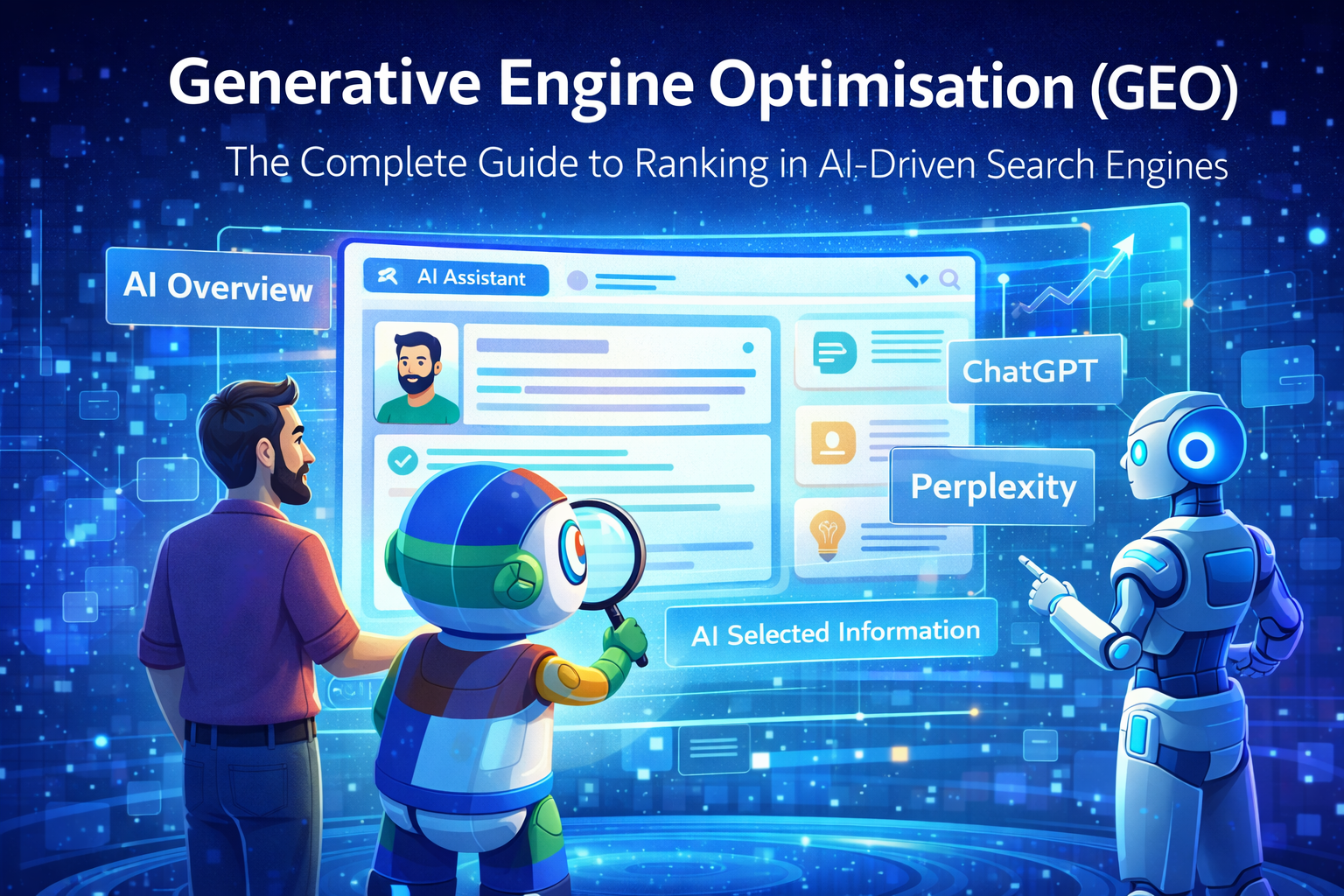
Introduction: The Structural Shift from Search to AI
Search behaviour has fundamentally changed. Users no longer type keywords and compare links. They ask questions and expect complete answers instantly. AI systems now generate responses rather than ranking pages, transforming search into an answer-first ecosystem. Google through AI Overviews, OpenAI via ChatGPT, and Perplexity AI reflect this broader shift, not isolated tools. Traditional SEO alone cannot secure visibility inside generated responses. This guide introduces Generative Engine Optimisation (GEO) as the logical evolution of search strategy. It explains what GEO is, how AI systems choose answers, why GEO matters for visibility, and how to implement it correctly for long-term relevance.
What Is Generative Engine Optimisation (GEO)?
Generative Engine Optimisation (GEO) is the practice of structuring content so AI systems can select, synthesise, and reference it when generating answers. Unlike traditional optimisation, GEO focuses on answer inclusion rather than rankings, impressions, or clicks. The goal is to become a trusted source inside AI responses. GEO targets how information is understood and reused, not how pages perform in search results. It is not keyword stuffing, not prompt engineering, and not chatbot optimisation. GEO is a content strategy designed to meet intent fully, clearly, and credibly so AI systems can rely on it.
How Generative Search Engines Decide What to Answer
Generative search engines retrieve information from indexed, trusted web sources before producing responses. Selection depends on clarity, completeness, and contextual relevance. Content that is ambiguous, overly promotional, or shallow is ignored. AI systems favour material that resolves the entire intent rather than partial explanations. In AI-driven search optimisation, usefulness is measured by how confidently an answer can be delivered. Content that anticipates follow-up questions and explains concepts thoroughly is more likely to be selected. The decision process rewards precision, depth, and coherence rather than surface-level summaries or fragmented insights.
GEO vs Traditional SEO: Where the Strategy Fundamentally Changes
Traditional SEO optimises pages to rank. GEO optimises information to be reused. With zero-click search becoming common, visibility no longer depends on organic visits. AI systems select explanations, not pages. This shifts optimisation from producing the “best page” to delivering the “best explanation.” GEO in SEO complements ranking strategies but changes success metrics entirely. Performance is measured by reference, citation, and inclusion inside answers. Content may never receive traffic yet still influence users through AI-generated responses, redefining how success is evaluated.
Why GEO Is Business-Critical in 2026 and Beyond
As AI answers replace traditional result pages, brands that are not referenced lose visibility entirely. Being cited builds perceived authority and trust at scale. GEO for AI search engines creates early advantage in industries where adoption remains low. Once AI systems establish trusted sources, displacement becomes difficult. GEO should be viewed as a long-term visibility asset rather than a traffic tactic. It protects relevance as interfaces evolve and reduces dependence on volatile ranking positions. Organisations that delay GEO adoption risk becoming invisible within AI-mediated discovery environments.
Content Planning Strategy for GEO
Content planning for GEO prioritises questions and problem resolution. Answer-based search rewards material that directly addresses user intent and related sub-questions within one structure. Topic clusters should cover primary queries and their logical extensions. Single-angle articles underperform because AI must combine multiple sources to form answers. Generative search optimisation favours depth over frequency. Publishing fewer, comprehensive pieces increases the likelihood of selection. Content should be scoped to explain, clarify, and resolve rather than introduce topics superficially or rely on external context.
On-Page Content Structuring for AI Extraction
Each H2 should answer one specific sub-question clearly. The opening lines must provide a direct response before supporting detail. Bullet points help AI systems extract structured meaning when outlining steps, criteria, or definitions. Formatting reduces interpretation effort and ambiguity. Optimising for AI search engines requires precision in language and hierarchy. Structured data should only be used when it reinforces clarity and context. The objective is to make content easy to interpret, reuse, and trust without requiring inference or reconstruction.
Authority, Trust, and E-E-A-T in GEO
AI systems favour sources that demonstrate accountability and expertise. Identifiable authorship and subject alignment increase credibility. Referencing reliable external sources strengthens validation signals. Content freshness matters because outdated information introduces risk. AI-generated answers rely on confidence that information is accurate, current, and responsibly produced. Alignment between brand focus, author background, and content topics reinforces trust. In GEO, authority is inferred through consistency and transparency rather than claims or credentials listed without context.
Common GEO Implementation Errors
Keyword-driven content fails because AI systems do not select text based on density. Thin summaries and duplicated articles provide insufficient confidence for reuse. Ignoring authorship weakens credibility signals. Failing to update content reduces trust over time. AI-driven search optimisation penalises these issues through exclusion rather than demotion. Content may remain indexed but never referenced. GEO errors limit answer inclusion, which effectively removes visibility inside AI responses even when traditional SEO fundamentals appear intact.
Conclusion: Making GEO a Core Content Strategy
Generative Engine Optimisation (GEO) represents a structural shift in how visibility is earned. It is not a short-term trend tied to interface changes. Organisations should begin with audits, then restructure content for clarity, authority, and completeness. GEO rewards consistent expertise development rather than volume publishing. As AI systems increasingly mediate access to information, GEO becomes foundational for sustained authority and relevance. Treating GEO as a core content strategy ensures long-term presence inside AI-driven search environments rather than reliance on declining click-based models.
At Southern Sages, we treat GEO as a long-term content discipline, not a short-term SEO adjustment. Our focus is on helping brands prepare for AI-led discovery by building clarity, authority, and structured expertise into every content layer. If you’re looking for SEO services the best SEO company in Riyadh is there to support, we work closely with businesses ready to invest in sustainable visibility, trusted content systems, and long-term relevance in AI-driven search environments.