
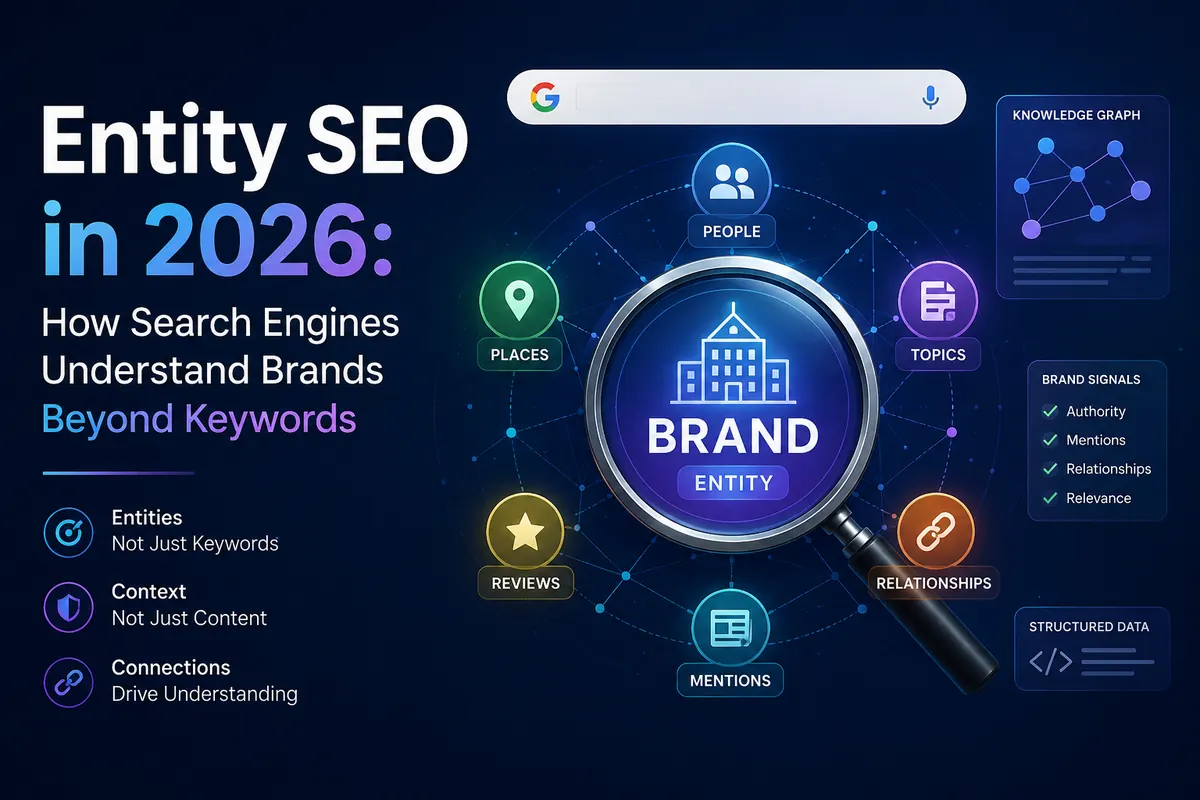
Entity SEO in 2026: How Search Engines Understand Brands Beyond
Keywords About ten years back, keyword optimization for SEO was all about embedding the targeted keyword into titles, headings, meta tags, and other parts of the content. This shift has made Entity SEO in 2026 one of the most important components of a future-ready Entity SEO strategy. Even though keywords continue to hold importance, contemporary search engines are increasingly striving to comprehend and understand people, companies, products, locations, and topics as entities.
Today, Google, AI-driven search engines, and answer generation systems rely on such signals as a way of understanding:
● Who the brand is
● What the brand does
● Which topics it is associated with
● Which people, products, and locations belong to it
● Whether independent sources corroborate those relationships
● Whether the brand is a credible source for a subject
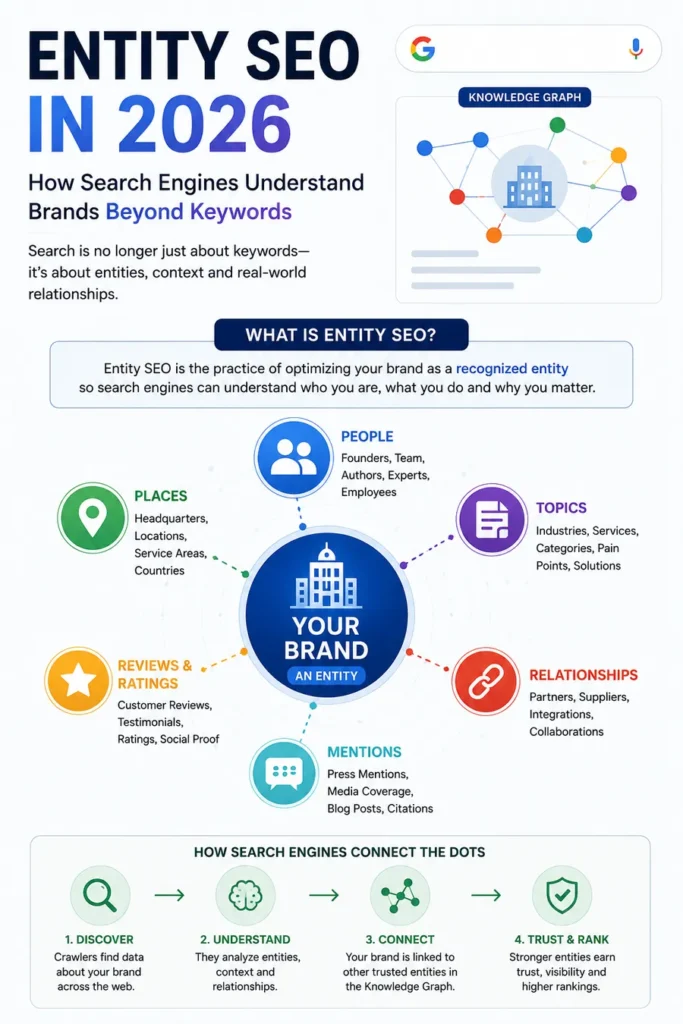
What Is Entity SEO and How Does It Work in 2026?
What Is an Entity in SEO?
For SEO, an entity refers to a definable individual, organization, product, location, concept, or other item which can be distinguished by the search engine irrespective of any particular keyword. The following are examples of entities:
● Southern Sages
● Kochi
● Digital marketing agency
● Search engine optimization
● Google Knowledge Graph
● Artificial intelligence Whereas keywords lack these elements, entities have identity, attributes, and relationships which can be used by search engines to determine the meaning of a query.
Keywords vs Entities: “Strings” and “Things”
Here is how traditional SEO looked like::
Keyword → Webpage → Ranking
Entity based SEO looks rather like this::
Entity → Relationships → Relevance → Authority → Search visibility / AI citation
Though keywords play an important role in connecting with the purpose of the search, Entity SEO makes more meaningful connections in relation to the background of the content creator. That’s where semantic SEO comes into play.
Why Entity SEO Matters More for Brands in 2026
Signals include:
- Consistent brand identity
- Branded searches
- Independent brand mentions
- Author and company information
- Reviews and reputation signals
- Relevant citations
- Topic associations
- Consistent business information across platforms
The above signals constitute brand authority signals in SEO and help search engine algorithms feel confident in the brand’s authenticity.
A very effective strategy is the one which includes:
- Page-level keyword relevance
- Entity clarity
- Useful content
- Authority and trust signals
How Search Engines Understand a Brand as an Entity
Google Knowledge Graph and Entity Relationships
Google’s knowledge graph is a vast repository of inter-related entities and facts. This allows Google to comprehend the connection between organizations, individuals, products, places, and topics.
For example, Google may connect:
- Southern Sages → Digital strategy
- Southern Sages → Kochi
- Southern Sages → SEO consulting
- Southern Sages → Content marketing
Entity Attributes, Relationships, and Context
A search system analyses three levels.
Attributes
Basic factual information:
- Business name
- Location
- Founders
- Services
- Contact information
- Industry category
Relationships
Connections between entities:
- Brand ↔ Founder
- Brand ↔ Service
- Brand ↔ Location
- Author ↔ Topic
- Product ↔ Category
Context
The broader question:
What is this brand consistently known for?
If a business frequently produces top-notch information regarding SEO, content marketing, semantic SEO, AI visibility, and digital growth, the search systems will start linking that entity with these concepts.
Entity Disambiguation
There are many companies with the same name. The search engines need to figure out which one they are talking about.
Consistency is critical:
- Same brand name everywhere
- Same business description
- Same website URL
- Same social profiles
- Same location details
Effective entity disambiguation prevents confusion and boosts entity SEO performance.
Entity SEO and AI Search: Why Brand Recognition Matters Beyond Google Rankings
Traditional SEO Visibility
- Rank a URL
- Earn clicks from search results
- Optimize individual pages
AI Search Visibility
- Be referenced
- Be cited
- Be recommended
- Be included in generated answers
Signals that may support AI search visibility include:
- Brand mentions on independent websites
- Relevant industry citations
- Clear topical associations
- Verified author identity
- Consistent company descriptions
- Reviews and community discussions
- Structured brand information
- Branded search demand
How to Build a Strong Brand Entity for SEO in 2026
This is the most actionable part of an effective Entity SEO strategy.
1. Create a Clear Brand Identity
Ensure that your:
- Brand name
- Tagline
- Service descriptions
- Location
- Contact information
- Website URL
remain consistent across all platforms, including social media, directories, business listings, and industry profiles.
2. Implement Structured Data
Use appropriate Schema.org markup to help search engines understand your entity.
Important schema types include:
- Organization
- Person
- LocalBusiness
- Service
- Product
- Article
- BreadcrumbList
Structured data should accurately reflect the visible content on the page.
3. Strengthen Your About and Author Pages
Many websites treat the About page as an afterthought. In brand entity SEO, it is a critical trust signal.
Include:
- Company history
- Expertise areas
- Team members
- Credentials
- Service specializations
- Business registration details where appropriate
- Real contact information
Author pages should connect individuals with the topics they regularly cover, reinforcing author-to-topic entity relationships.
4. Build Topic and Entity Relationships Through Content
Create topic clusters that connect your brand with its core expertise.
For example:
- Entity SEO in 2026
- Semantic SEO strategies
- Google Knowledge Graph optimization
- AI search visibility
- Technical SEO foundations
- Content authority building
Interlink these resources to strengthen topical authority and reinforce entity associations.
5. Earn Brand Mentions and Citations
Develop visibility beyond your own website through:
- Industry publications
- Digital PR
- Podcasts
- Interviews
- Webinars
- Professional directories
- Review platforms
- Relevant community discussions
6. Build Branded Search Demand
Strong brands generate searches for their own name.
Encourage branded searches through:
- Social media campaigns
- Video content
- Thought leadership articles
- Email marketing
- Offline events
- Public speaking
- Industry partnerships
Branded search demand is a powerful signal that people actively recognize and seek out your business.
Entity SEO vs Traditional Keyword SEO: Do Keywords Still Matter?
|
Keyword SEO |
Entity SEO |
|---|---|
|
Targets search queries |
Builds identifiable subjects |
|
Focuses on page relevance |
Focuses on meaning and relationships |
|
Uses keyword research |
Uses entities, attributes, and topics |
|
Optimizes individual pages |
Connects the brand across the web |
|
Supports rankings |
Supports recognition, rankings, and AI visibility |
The strongest SEO model in 2026 is:
Keyword relevance + Entity clarity + Useful content + Authority signals = Stronger search visibility
Entity SEO does not replace keyword research. Instead, it enhances traditional SEO by helping search engines understand who is providing the information and why that source should be trusted.
How to Measure Entity SEO Performance
Entity SEO should be measured with concrete KPIs rather than treated as a vague branding exercise.
Track the following metrics.
- Branded search impressions and clicks
- Growth in branded queries
- Brand mentions and citations
- Knowledge Panel presence and accuracy
- Organic visibility across core topic clusters
- Referral traffic from authoritative mentions
- AI citations and brand mentions
- Search visibility for brand + service combinations
- Consistency of entity information
- Growth in authoritative referring domains
Entity SEO Mistakes That Can Weaken Brand Recognition
Even well-designed websites can undermine their entity signals through avoidable mistakes.
Common Entity SEO mistakes include:
- Inconsistent brand names across platforms
- Conflicting company descriptions
- Keyword stuffing
- Thin or generic About pages
- Missing author information
- Incorrect or excessive schema markup
- Structured data that does not match visible content
- Publishing disconnected content outside the brand’s expertise
- Depending only on backlinks
- Ignoring independent brand mentions
- Creating duplicate business profiles
- Treating entity SEO as a substitute for technical SEO, content quality, or user experience
A strong entity optimization strategy must work alongside technical SEO, content quality, site performance, and UX.
Key Questions
Use this checklist to evaluate your Entity SEO strategy.
- Does Google clearly understand who your brand is?
- Is your brand consistently represented across the web?
- What topics does your brand want to be recognized for?
- Are your brand entities and relationships clearly connected?
- Are you using structured data correctly?
- Does your website demonstrate topical authority?
- Does your brand have credible mentions outside its own website?
- Can search and AI systems associate your brand with its core topics?
If several of these questions produce uncertain answers, your brand entity SEO foundation may need strengthening.
Conclusion
Entity SEO in 2026 signifies a shift in how search engines analyze websites. Contemporary search systems increasingly use entities, attributes, context, and relations to assess website relevance and authority.
While keywords are still important when matching content to user needs, brands need to have a clear identity understandable by computers too. Companies that use Semantic SEO, increase their links to the Google Knowledge Graph, and enhance AI searchability will gain an advantage in conventional and AI search scenarios.